Índice
What is a Plastic Pelletizing Line?
A linha de granulação de plástico is an industrial manufacturing system designed to convert plastic waste or raw plastic polymers into uniform, clean, and easily transportable pellets (granules).
These extruded pellets serve as the essential raw material for downstream plastic manufacturing processes, such as injection molding, blow molding, and film blowing. Essentially, it bridges the gap between plastic waste management and brand-new product creation.
How It Works: The Step-by-Step Process

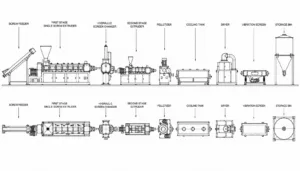
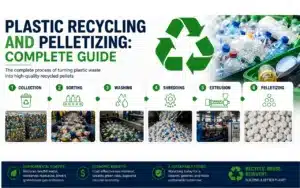
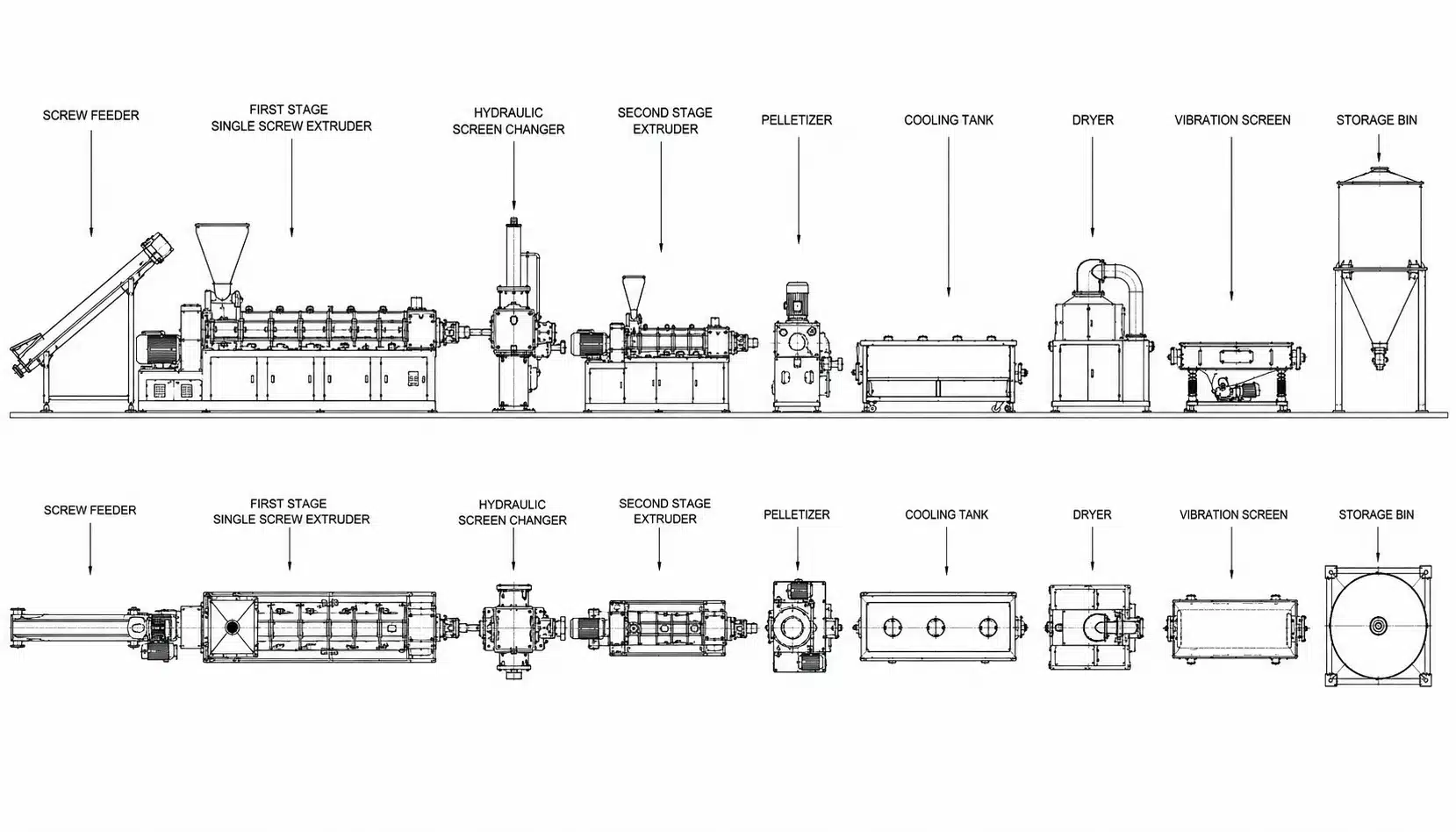
A pelletizing line is not a single machine, but a highly integrated sequence of specialized components. While configurations vary based on the specific type of plastic being processed (e.g., rigid plastics vs. soft films), a standard lines follows these core stages:
The process begins with the raw material—which could be shredded rigid plastics (like PE, PP, ABS, or PET) or compacted soft plastics (like film flakes). This material is fed into the system via hopper feeders, belt conveyors, or a force-feeder designed to handle low-density materials without clogging.
Extrusion and Melting
This is the heart of the system. The plastic enters the extruder barrel, where a rotating screw subjects the material to intense mechanical shear and controlled electrical heating.
Melting & Homogenizing: The plastic is completely melted and mixed into a uniform, molten mass.
Degassing/Venting: High-efficiency vacuum degassing ports are critical here. They pull out moisture, volatile gases, and ink residues from the molten plastic to ensure the final pellets are solid and free of internal air bubbles.
Filtration (Screen Changing)
Before the molten plastic is shaped, it must be completely pure. A hydraulic screen changer filters out any remaining non-plastic contaminants (such as paper fibers, wood bits, or aluminum traces) without halting production.

Pelletizing (The Cutting Phase)
Once filtered, the clean, molten plastic is forced through a die plate to be cut into uniform pellets. Depending on the material’s properties and the manufacturer’s requirements, one of two primary cutting systems is used:
Strand Pelletizing System : The molten plastic is extruded into long, noodle-like strands. These strands travel through a water cooling tank to solidify before being pulled into a high-speed rotary cutter that chops them into precise cylindrical pellets.
Water-Ring / Underwater Pelletizing System: The plastic is cut by rotating blades immediately as it emerges from the die face. The freshly cut, hot pellets are instantly swept away by a cooling water flow. This method is highly automated, space-saving, and ideal for high-capacity lines or sticky materials.
Dewatering and Packing

If a water-cooling method was used, the wet pellets enter a centrifugal dewatering machine to spin off excess moisture. Finally, a cooling blower transports the bone-dry, pristine pellets into a storage silo or directly into packing bags, ready for sale or reuse.
Key Classifications of Pelletizing Lines
To achieve the highest efficiency, pelletizing lines are tailored to the shape and properties of the input material:
| Line Type | Best For | Key Feature |
|---|---|---|
| Single-Stage Extrusion | Clean industrial scrap, regrind material with low contamination. | Straightforward, energy-efficient, and cost-effective. |
| Two-Stage (Mother-Baby) Extrusion | Highly contaminated or heavily printed post-consumer waste, wet flakes. | Two extruders in series. The first melts and filters; the second focuses on deep degassing and final extrusion, ensuring superior pellet quality. |
| Compacting & Pelletizing System | Low-bulk-density materials like PE/PP plastic films, woven bags, and raffia. | Features an integrated cutter-compactor that shreds, friction-heats, and densifies fluffy film into the extruder in one seamless step. |
Why Is It Crucial for the Industry?
Resource Circularity: It turns environmental liabilities (plastic waste) into valuable economic assets.
High Consistency: Modern lines feature advanced PLC automation, ensuring the resulting pellets have consistent density, size, and melt flow index (MFI)—qualities that downstream factories demand.
Optimized Logistics: Fluffy plastic scrap or irregular regrind takes up massive shipping volume. Converting it into dense, uniform pellets drastically reduces transportation and storage costs.
Whether you are running a high-output B2B factory supplying the global market or upgrading an existing recycling plant, choosing the right configuration—from the screw design to the cutting system—is the ultimate key to maximizing throughput and output purity.
Would you like to dive deeper into the technical differences between specific configurations, such as comparing a strand pelletizing line versus a water-ring system for a specific material like PP or PE?
Perguntas frequentes sobre a linha de granulação de plástico
Q: How Much Does a Plastic Pelletizing Line Cost?
R:
Aproximadamente entre 10.000 e 50.000 dólares americanos, dependendo do material, da capacidade e da configuração.
Q: How do I choose the right pelletizing line?
R:
The correct pelletizing line depends on:
- Tipo de matéria-prima
- Teor de umidade
- Nível de contaminação
- Capacidade de saída necessária
- Tamanhos desejados de pellets
- Aplicação final
Diferentes aplicações podem exigir peletizadoras de fios, peletizadoras de anel de água, peletizadoras subaquáticas ou sistemas de peletização de face de matriz.
Q: How To Source Plastic Pelletizing Line In China?
R:
Sourcing a Linha de granulação de plástico from China offers an incredible balance of cutting-edge automation and cost efficiency, but navigated incorrectly, it can lead to massive logistical headaches. Machinery sourcing requires deep technical vetting since these lines are rarely “off-the-shelf”—they must be custom-configured to your specific raw input material.
Here is the strategic blueprint for successfully sourcing a high-performance pelletizing line directly from Chinese manufacturers.
Know the Industrial Hubs (Where to Look)
In China, machinery manufacturing clusters geographically. Knowing where a factory is located tells you a lot about their supply chain and specialization:
Zhangjiagang & Suzhou (Jiangsu Province): The undisputed capital of plastic recycling machinery. Zhangjiagang hosts hundreds of top-tier extrusion and recycling equipment factories (such as Mooge, Polytec, Fosita, and Retec). Sourcing here gives you access to a highly mature ecosystem, meaning competitive pricing and easy access to high-quality auxiliary components (like screen changers, shredders, and water pumps).
Ningbo & Yuyao (Zhejiang Province): Excellent for injection molding machines, compounding lines, and smaller-scale single/twin-screw recycling extruders.
Dongguan (Guangdong Province): The core area of plastic machinery in Guangdong. Here, a large number of manufacturers specializing in mid-to-high-end extrusion machines, functional masterbatch granulation lines, and sheet/film extrusion lines are concentrated. The mechanical manufacturing industry in Foshan has an extremely profound foundation. Its processing accuracy and overall machine stability rank first in the southern region.