目次
What Is a Plastic Pelletizing Machine?
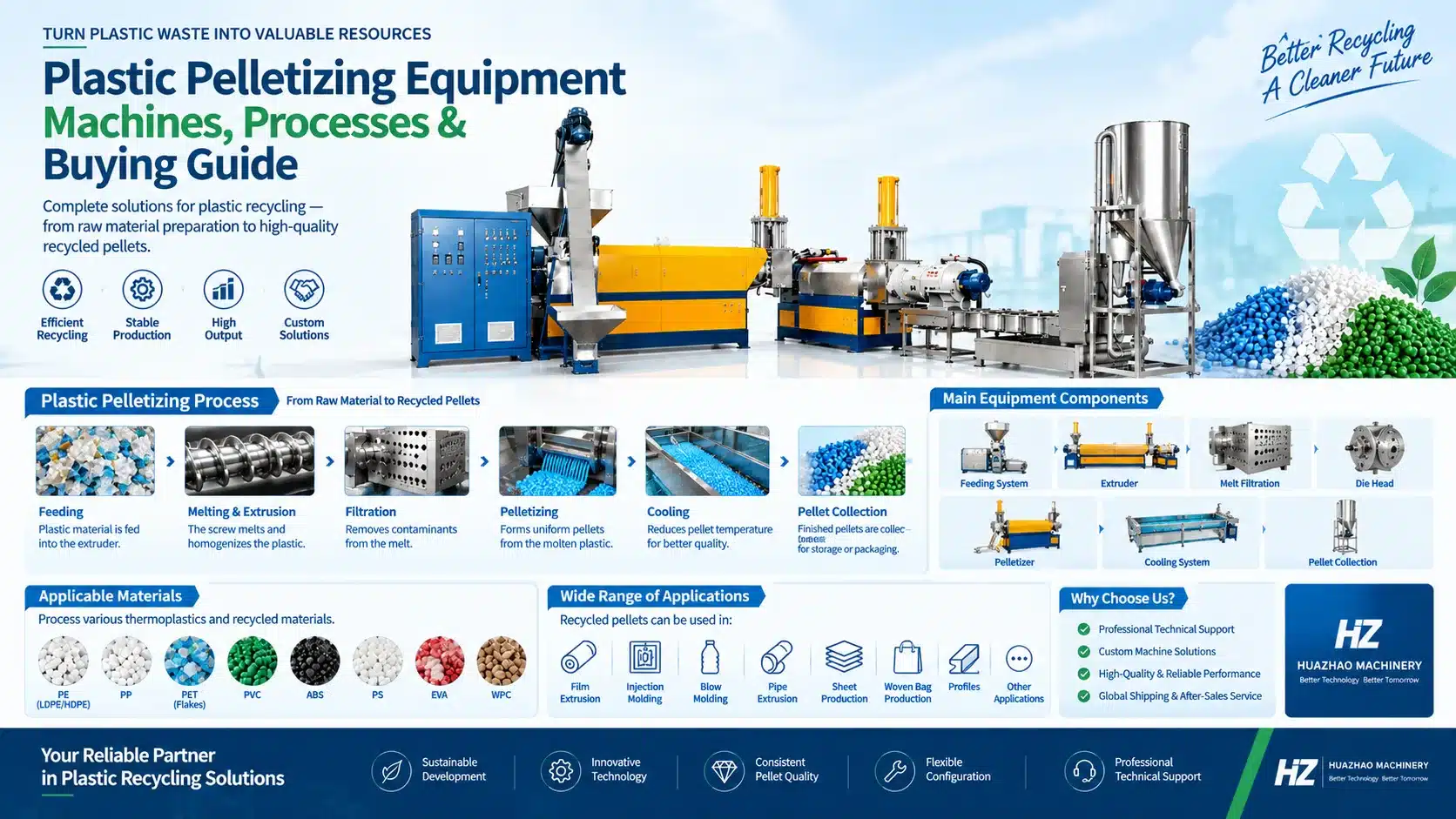
A plastic pelletizing machine is an extrusion-based recycling machine that melts and homogenizes plastic material before converting it into small, uniform pellets.
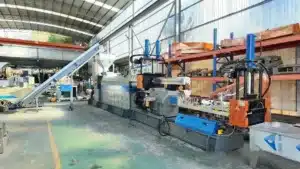
The machine typically includes a feeding system, extruder, heating and temperature-control system, melt filtration system, pelletizing system, cooling system, and pellet collection equipment.
Depending on the material and production requirements, different pelletizing technologies can be used.
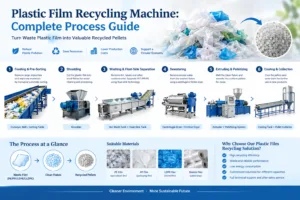
A typical plastic recycling pelletizing process is:
Plastic Waste → Shredding / Washing → Drying → Feeding → Extrusion → Melt Filtration → Pelletizing → Cooling → Pellets
The final pellets can be used as recycled raw material for injection molding, extrusion, blow molding, film production, pipe production, and other plastic manufacturing applications.
How Does a Plastic Pelletizing Machine Work?
The working principle of a plastic pelletizing machine is based on controlled melting, mixing, filtration, and pellet formation.
1. Plastic Waste Preparation
Before entering the pelletizer, plastic waste normally needs to be prepared according to its condition.
For post-consumer or heavily contaminated plastic, the recycling process may include:
Sorting
Shredding
粉砕
洗濯
Friction washing
Dewatering
Thermal drying
Storage
For relatively clean industrial plastic waste, washing may not be necessary.
For example, clean production scrap, plastic edge trim, and some factory-generated film waste can often be processed with a simpler preparation system.
2. Feeding
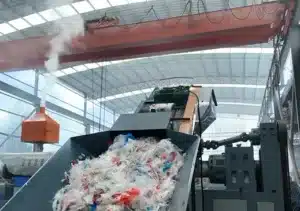
Prepared plastic flakes or film are continuously fed into the extruder.
Film and lightweight materials can be more difficult to feed because they have a low bulk density. A suitable forced-feeding or compacting system can help maintain stable material feeding.
The feeding system should be matched to the characteristics of the raw material rather than simply selected according to the required output.
3. Extrusion and Melting
Inside the extruder, the plastic is transported forward by the rotating screw.
Controlled heating and mechanical shear gradually melt the plastic.
The extrusion process also helps:
Homogenize the melt
Disperse additives
Remove some volatile substances
Stabilize the material flow
Prepare the melt for filtration and pelletizing
Temperature control is particularly important because different plastics have different processing temperatures.
For example, PE, PP, PET, PVC, EVA, ABS, and other materials require different extrusion conditions.
4. Melt Filtration
Before pelletizing, the molten plastic passes through a screen or filtration system.
The purpose is to remove contaminants such as:
Paper
Aluminum
Wood particles
Unmelted impurities
Foreign plastic particles
Other solid contaminants
For recycling plants processing dirty or printed plastic film, an efficient melt filtration system can significantly improve pellet quality and reduce production interruptions.
Automatic or laser-assisted screen-changing systems can also be used when continuous production and stable filtration are important.
5. Pelletizing
After filtration, the molten plastic is converted into pellets.
One common method is strand pelletizing.
In this process, molten plastic is extruded through a die to form continuous strands. The strands are cooled and then cut into pellets by a strand pelletizer.
The pelletizing method should be selected according to the material, melt properties, production capacity, and desired pellet characteristics.
6. Cooling and Collection
The newly formed pellets are cooled and separated from the cooling medium before being collected.
The finished recycled pellets can then be stored in bags, silos, or other material-handling systems.
What Plastics Can Be Processed by a Plastic Pelletizing Machine?
Plastic pelletizing machines can be configured for different types of thermoplastics.
Common materials include:
| Plastic Material | Typical Recycling Applications |
|---|---|
| LDPE | Plastic film, agricultural film, packaging film |
| HDPE | Bottles, containers, pipes, industrial plastic |
| PP | Woven bags, raffia, containers, automotive plastic |
| PET | PET flakes and polyester-related recycling applications |
| ABS | Engineering plastic waste and production scrap |
| PS | Polystyrene waste and industrial scrap |
| PVC | PVC production waste and selected recycled PVC streams |
| EVA | EVA film, production scrap and other suitable waste |
| WPC | Wood-plastic composite materials |
| Masterbatch | Filler and color masterbatch production |
However, one pelletizing line is not automatically suitable for every type of plastic.
Different polymers may require different screw designs, temperature profiles, feeding systems, filtration systems, and pelletizing methods.
For commercial recycling projects, the material should therefore be evaluated before selecting the machine configuration.
Plastic Recycling Pelletizing Machine vs. Plastic Pelletizer
The terms plastic pelletizing machine, plastic pelletizer, and plastic pelletizer machine are often used interchangeably.
However, they can sometimes refer to different parts of a recycling system.
A plastic pelletizing machine generally refers to the complete extrusion and pelletizing equipment.
A plastic pelletizer can also refer specifically to the equipment that cuts or forms pellets after extrusion.
For example, a strand pelletizing system may include:
Extruder → Screen Changer → Die Head → Water Cooling → Strand Pelletizer → Pellet Collection
Therefore, when comparing suppliers, it is important to check whether the quoted equipment is a complete plastic pelletizing system or only the pelletizing section.
Plastic Pelletizing Machine for Different Raw Materials
PE Film Pelletizing
PE film is one of the common materials processed by plastic recycling pelletizing machines.
Typical sources include:
Post-industrial PE film
Packaging film
農業用フィルム
Stretch film
LDPE film
HDPE film
Film recycling usually requires special consideration for feeding, compaction, moisture removal, and melt filtration.
For washed post-consumer film, the washing and drying stages are particularly important before extrusion.
PP Woven Bag Pelletizing
PP woven bags and raffia waste can be processed into recycled PP pellets.
The process may include:
Sorting → Cutting/Shredding → Washing if required → Drying → Extrusion → Filtration → Pelletizing
For relatively clean PP woven waste, the system can be simplified.
HDPE Pelletizing
HDPE waste can come from bottles, containers, drums, pipes, and industrial production scrap.
Depending on the raw material, an HDPE pelletizing machine may be combined with a washing line or used directly with clean regrind.
The final recycled HDPE pellets can be used in various extrusion and injection molding applications, depending on the required quality.
PET Flakes Pelletizing
PET Pelletizing requires more precise material preparation than many PE and PP applications.
PET flakes should normally have controlled moisture and contamination levels before entering the pelletizing process.
For high-quality PET recycling, the process may include:
Bottle Sorting → Crushing → Washing → Separation → Drying → PET Flakes → Extrusion → Melt Filtration → Pelletizing
PET processing may require specialized screw and drying technology because moisture can cause hydrolysis during processing.
PVC Pelletizing
PVC requires careful temperature control because excessive processing temperature can cause degradation.
A PVC pelletizing machine therefore needs to be designed specifically for the material and formulation being processed.
The appropriate screw configuration, temperature control, stabilizer system, and processing conditions should be determined according to the customer’s PVC material.
Plastic Pelletizing Machine for Film, Flakes and Regrind
The physical form of the raw material is another important factor.
Plastic Film
Film has a low bulk density and can be difficult to feed.
A compacting or force-feeding system may be required to achieve stable extrusion.
Plastic Flakes
Plastic flakes generally have a higher bulk density than film and are easier to feed.
However, the flake size and moisture content still affect feeding stability and extrusion performance.
Plastic Regrind
Clean plastic regrind from industrial production can often be processed with relatively simple feeding and extrusion systems.
This can reduce the overall complexity of the recycling line.
What Is the Capacity of a Plastic Pelletizing Machine?
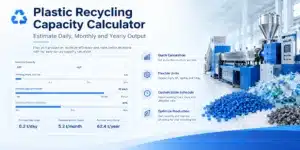
The required capacity should be determined according to the actual material and operating conditions.
Typical recycling projects may require capacities ranging from a few hundred kilograms per hour to more than 1,000 kg/h.
例えば:
250–400 kg/h: Small to medium recycling projects
400–600 kg/h: Medium production
600–1,000 kg/h: Larger recycling operations
1,000+ kg/h: High-capacity industrial applications
However, the nominal output of an extruder should not be treated as a guaranteed production rate for every material.
The actual capacity depends on:
Plastic type
Bulk density
水分
Contamination
Feeding method
Screw design
Screen filtration
Melt temperature
Material formulation
Required pellet quality
A supplier should therefore calculate the expected output based on the customer’s actual raw material rather than providing capacity based only on the machine model.
How to Choose a Plastic Pelletizing Machine
Choosing the right machine starts with the raw material.
1. Identify the Plastic Type
Determine whether the material is:
PE
PP
PET
HDPE
LDPE
PVC
ABS
PS
EVA
Mixed plastic
Different polymers require different processing configurations.
2. Check the Raw Material Form
Is the material:
Film?
Flakes?
Regrind?
Woven bags?
Rigid plastic?
Production scrap?
This directly affects the feeding system.
3. Check Moisture Content
Moisture is especially important when processing washed plastic flakes.
Insufficient drying can lead to:
Bubbles
Poor pellet appearance
Unstable extrusion
Reduced material properties
Increased pressure fluctuations
4. Evaluate Contamination
The level and type of contamination determine the required filtration technology.
Clean industrial scrap may require relatively simple filtration.
Post-consumer waste may require more advanced melt filtration.
5. Determine Required Capacity
Capacity should be based on the actual raw material rather than the theoretical maximum output.
It is also important to distinguish between:
Machine rated capacity
and
Actual stable production capacity
For a recycling plant, stable long-term production is usually more important than a high theoretical output.
6. Define the Final Pellet Application
The final use of the recycled pellets affects the required pellet quality.
For example, recycled pellets used for:
Garbage bags
Woven bags
Plastic sheets
Pipes
Injection molding
Blow molding
Film extrusion
may have different quality requirements.
Plastic Pelletizing Machine Price: What Affects the Cost?
There is no single standard price for a plastic pelletizing machine because recycling systems are normally configured according to the material.
The total project cost can be affected by:
Extruder size
モーター出力
Screw design
Feeding system
Compactor
Screen changer
Filtration accuracy
Pelletizing method
Automatic controls
Cooling system
Pellet collection system
Washing and drying equipment
Auxiliary equipment
Installation and commissioning
A complete plastic recycling pelletizing line will naturally cost more than a standalone pelletizing machine.
For this reason, comparing suppliers only by machine price can be misleading.
A better comparison considers:
Purchase Cost + Energy Consumption + Maintenance + Spare Parts + Production Stability + Service Life
The lowest initial price does not always result in the lowest cost per kilogram of recycled pellets.
Complete Plastic Recycling Pelletizing Line
For contaminated post-consumer plastic, the pelletizing machine is only one part of the recycling project.
A complete line may include:
Sorting System
↓
Shredder / Crusher
↓
Washing System
↓
Dewatering
↓
Thermal Drying
↓
Feeding System
↓
Plastic Extruder
↓
Melt Filtration
↓
Die Head
↓
Pelletizing System
↓
Cooling
↓
Pellet Collection
The exact configuration depends on the customer’s raw material.
For clean post-industrial waste, a complete washing line may not be necessary.
For heavily contaminated post-consumer plastic, washing, drying, and advanced filtration become much more important.
Why Work With a Custom Plastic Pelletizing Machine Manufacturer?
Every recycling project has different raw material characteristics.
A customized plastic pelletizing machine can be designed around:
Material type
Material contamination
Moisture level
Input form
Required capacity
Pellet size
Final application
Available factory space
Local electricity specifications
Automation requirements
For example, a PE film recycling project may require a different feeding and extrusion configuration from an HDPE rigid plastic project.
Similarly, a PET flakes pelletizing line requires different preparation and drying considerations than a PP woven bag recycling line.
This is why a material test and technical evaluation are valuable before finalizing the machine configuration.
Choosing Plastic Pelletizing Machine for Your Recycling Project
A plastic pelletizing machine is an important part of a plastic recycling process, but the right configuration depends on the actual material and production requirements.
Before selecting a machine, consider:
Plastic type
Material form
Moisture content
汚染レベル
Required capacity
Filtration requirements
Pellet quality
Final application
Whether you are processing PE film, PP woven bags, HDPE flakes, PET flakes, PVC, ABS, or other thermoplastics, the pelletizing system should be configured around the characteristics of the material.
For a new recycling project or an existing line upgrade, providing raw material photos or videos, material type, moisture and contamination information, required capacity, and final pellet application will help determine a suitable plastic pelletizing machine and complete recycling process.
Common Questions About Plastic Pelletizing Equipment
Q: What is a plastic pelletizing machine used for?
A:
A plastic pelletizing machine is used to convert suitable plastic waste, flakes, film, or regrind into recycled plastic pellets that can be reused in plastic manufacturing.
Q: Can a plastic pelletizing machine process mixed plastics?
A:
It depends on the material combination.
Some polymers can be processed together under controlled conditions, while others are incompatible or require separation.
For commercial recycling, it is generally better to process a consistent polymer stream whenever possible.
Q: Can plastic film be pelletized?
A:
Yes. PE and PP film are commonly processed through plastic pelletizing systems.
Because film has low bulk density, the feeding and compaction system is particularly important.
Q: Does plastic need to be washed before pelletizing?
A:
Not always.
Clean industrial plastic waste may be pelletized without washing. Contaminated post-consumer plastic normally requires sorting, washing, drying, and other preparation before extrusion.
Q: What is the difference between a plastic pelletizing machine and a plastic recycling machine?
A:
A plastic pelletizing machine specifically converts plastic material into pellets.
A plastic recycling machine can refer to a wider range of equipment, including shredders, crushers, washing machines, dryers, extruders, pelletizers, and complete recycling lines.
Q: How do I choose the right plastic pelletizer?
A:
Start with the raw material.
Provide the supplier with information about the polymer, material form, contamination, moisture, required capacity, and final pellet application.
A professional manufacturer can then recommend the appropriate feeding, extrusion, filtration, and pelletizing configuration.