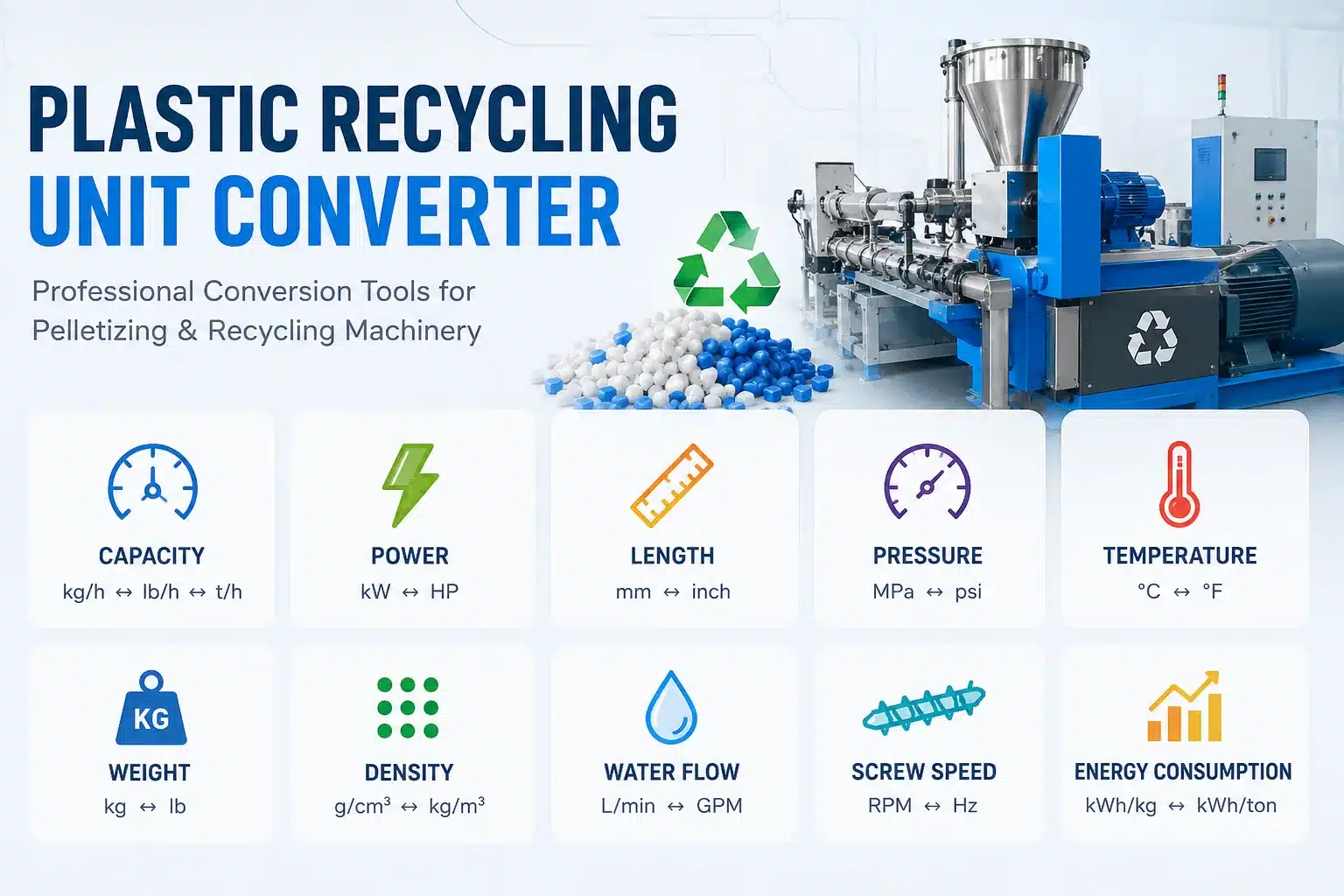
Plastic Recycling Unit Converter
Professional unit conversion tools for plastic pelletizing and recycling machinery.
Capacity Converter
Convert kg/h, lb/h and t/h for pelletizing machine output.
kg/h → lb/h
lb/h → kg/h
kg/h → t/h
Power Converter
Convert motor power units between kilowatts (kW) and horsepower (HP). This tool is useful for extruders, pelletizers, crushers and industrial recycling machinery.
kW → HP
HP → kW
Length Converter
Convert millimeters and inches for screw diameter, die head size, pellet dimensions and other plastic machinery measurements.
mm → inch
inch → mm
Pressure Converter
Convert hydraulic and extrusion pressure units between MPa and PSI. Commonly used for screen changers, hydraulic systems and extrusion equipment.
MPa → PSI
PSI → MPa
Temperature Converter
Convert Celsius and Fahrenheit temperatures for extrusion heating zones, melt temperature and industrial plastic processing systems.
℃ → ℉
℉ → ℃
Weight Converter
Convert machine weight and material weight units between kilograms and pounds for shipping, production and equipment specifications.
kg → lb
lb → kg
Density Converter
Convert plastic density units for PE, PP, ABS, PET and recycled plastic materials. Commonly used in pellet density and material specification calculations.
g/cm³ → kg/m³
Water Flow Converter
Convert cooling water flow units between liters per minute and GPM for water ring pelletizing systems and industrial cooling systems.
L/min → GPM
Energy Consumption Converter
Convert energy consumption units for plastic recycling and pelletizing production lines. Useful for evaluating machine efficiency and operating costs.
kWh/kg → kWh/ton
RFQ About Plastic Pelletizing Machine Unit Converter
Q: What does kg/h mean in pelletizing machines?
A:
kg/h stands for kilograms per hour. It is the standard unit used to measure the production capacity of plastic pelletizing machines. For example, a pelletizing line rated at 500 kg/h can process approximately 500 kilograms of plastic material every hour under normal operating conditions.
Q: Why do American customers use HP instead of kW?
A:
HP (horsepower) is a traditional power unit commonly used in the United States and some North American markets. Although kilowatts (kW) are widely used internationally, many American engineers and industrial buyers still prefer HP when evaluating motors, extruders and recycling machinery.
Q: How to convert MPa to psi?
A:
To convert MPa (megapascal) to psi (pounds per square inch), multiply the MPa value by 145.038. For example, 10 MPa is approximately equal to 1450 psi. This conversion is commonly used in hydraulic systems, extrusion pressure measurement and screen changer equipment.
Q: What is the standard screw diameter unit?
A:
Millimeters (mm) are the standard screw diameter unit used in most plastic extrusion and pelletizing machinery worldwide. However, inches are also commonly used in North America. For example, a 120 mm extruder screw diameter is approximately equal to 4.72 inches.
Q: Why is unit conversion important in plastic recycling machinery?
A:
Different countries and industries use different measurement systems. Unit conversion helps engineers, purchasing managers and machine operators accurately compare machine specifications, production capacity, power consumption and processing parameters for international projects and equipment sourcing.
Q: What units are commonly used in plastic pelletizing lines?
A:
Plastic pelletizing and recycling systems commonly use units such as kg/h, lb/h, kW, HP, mm, inch, MPa, psi, °C and °F. These units are used to describe production output, motor power, screw size, hydraulic pressure and temperature settings.
Q: How do you convert kW to HP?
A:
To convert kilowatts (kW) to horsepower (HP), multiply the kW value by 1.341. For example, a 75 kW motor is approximately equal to 100 HP. This conversion is widely used for extruders, crushers and pelletizing machine motors.
Q: Why do plastic recycling machines use MPa pressure units?
A:
MPa is commonly used because plastic extrusion and hydraulic systems operate under high pressure. Megapascal units provide a clear and accurate way to measure extrusion pressure, hydraulic pressure and screen changer performance in industrial recycling equipment.
Q: What is the common temperature unit in extrusion systems?
A:
Most plastic extrusion and pelletizing systems use Celsius (°C) as the standard temperature unit. However, Fahrenheit (°F) is still commonly used in the United States. Temperature conversion is important when comparing international machine specifications and process settings.
Q: What is GPM in water cooling systems?
A:
GPM stands for gallons per minute. It is a common flow rate unit used in American industrial cooling systems. In plastic pelletizing machinery, GPM is often used to measure cooling water flow in water ring pelletizers and cooling tanks.