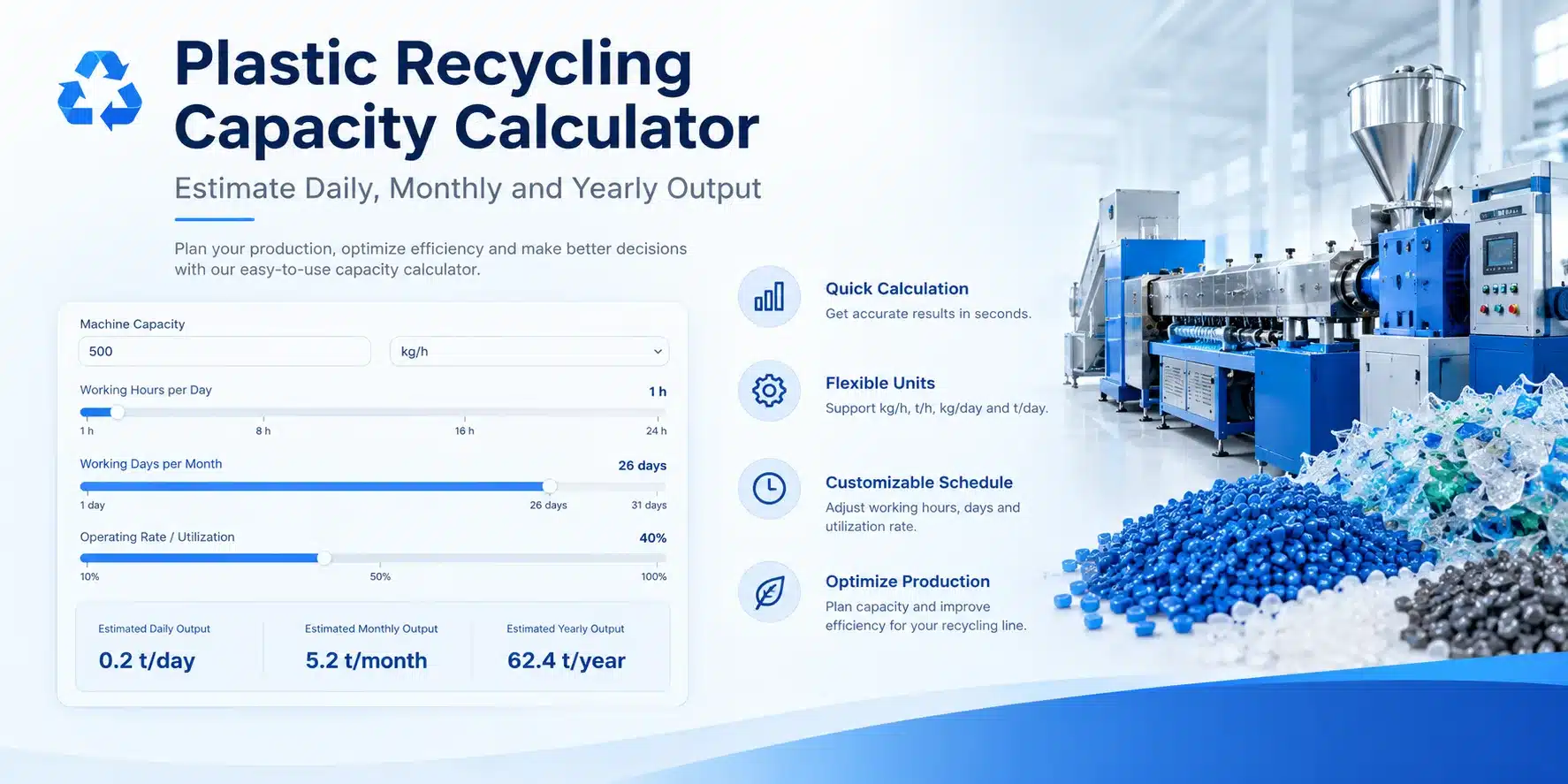
Plastic Recycling Capacity Estimate: KG/H — T/DAY, T/MONTH
Plastic Recycling Capacity Converter
Convert between hourly, daily, and monthly throughput for plastic shredders, washing lines, and pelletizing machines.
Enter or edit any one of the three capacity values to calculate the other two. Operating rate is applied when converting rated machine capacity into estimated actual throughput. When entering daily or monthly throughput, those values are treated as actual throughput. Actual results depend on material type, contamination, machine configuration, and operating conditions.
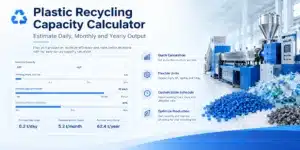
Plastic Recycling Capacity Calculator: Estimate Daily, Monthly and Yearly Output
Plastic recycling capacity determines how much plastic waste a recycling machine or production line can process over a specific period. Whether you are planning to purchase an industrial plastic shredder, a plastic washing line, or a plastic pelletizing line, estimating daily, monthly, and yearly throughput helps you evaluate production requirements, equipment sizing, and operating costs.
The Plastic Recycling Capacity Calculator below estimates processing output based on rated machine capacity, working hours per day, working days per month, and operating rate. You can adjust these values to compare different production schedules and estimate your plant’s processing capacity.
Plastic Recycling Capacity Calculator
Use this calculator to estimate the daily, monthly, and yearly processing capacity of your plastic recycling equipment.
Recommended default settings:
Machine Capacity: 500 kg/h
Working Hours per Day: 8 hours
Working Days per Month: 26 days
Operating Rate: 100% for theoretical capacity
Enter your machine’s rated capacity and operating schedule to calculate the estimated output. A lower operating rate can be used to account for downtime, feeding interruptions, maintenance, and production variation.
Insert the interactive Plastic Recycling Capacity Calculator here.
How to Calculate Plastic Recycling Capacity
Plastic recycling capacity is commonly measured in kilograms per hour (kg/h), tonnes per hour (t/h), or pounds per hour (lb/h). To estimate production over a day, month, or year, you need to combine the rated processing capacity with the operating schedule.
1. Daily Plastic Recycling Capacity Formula
Daily throughput is calculated using the machine’s hourly capacity, daily working hours, and operating rate.
Daily Capacity (t/day) = Machine Capacity (kg/h) × Working Hours per Day × Operating Rate ÷ 1,000
For example, a plastic recycling machine rated at 500 kg/h operating for 8 hours per day at 100% utilization has a theoretical daily capacity of:
500 × 8 × 100% ÷ 1,000 = 4 tonnes per day
If the operating rate is reduced to 80%, the estimated daily output becomes 3.2 tonnes.
2. Monthly Plastic Recycling Capacity Formula
Monthly throughput depends on daily output and the number of working days per month.
Monthly Capacity (t/month) = Daily Capacity (t/day) × Working Days per Month
For a 500 kg/h machine operating 8 hours per day for 26 days per month at 100% utilization:
500 × 8 × 26 ÷ 1,000 = 104 tonnes per month
If the operating rate is 80%, the estimated monthly output becomes 83.2 tonnes.
3. Yearly Plastic Recycling Capacity Formula
Yearly output can be estimated from monthly output and the number of operating months per year.
Yearly Capacity (t/year) = Daily Capacity (t/day) × Working Days per Month × Operating Months per Year
For example, a 500 kg/h machine operating 8 hours per day, 26 days per month, and 12 months per year has a theoretical annual capacity of:
500 × 8 × 26 × 12 ÷ 1,000 = 1,248 tonnes per year
This estimate assumes 100% utilization. For a more realistic production plan, account for scheduled maintenance, holidays, equipment downtime, and changes in raw material supply.
Daily, Monthly and Yearly Capacity Calculation Examples
The following table compares the theoretical processing capacity of a 500 kg/h plastic recycling machine under different working schedules.
| Working Hours per Day | Working Days per Month | Daily Capacity | Monthly Capacity | Yearly Capacity* |
|---|---|---|---|---|
| 8 hours | 26 days | 4 t/day | 104 t/month | 1,248 t/year |
| 8 hours | 30 days | 4 t/day | 120 t/month | 1,440 t/year |
| 16 hours | 26 days | 8 t/day | 208 t/month | 2,496 t/year |
| 24 hours | 26 days | 12 t/day | 312 t/month | 3,744 t/year |
Yearly capacity assumes the same monthly schedule is maintained for 12 months at 100% utilization.
These figures provide a useful starting point when planning production. Actual throughput may be lower because of material characteristics, machine configuration, operator practices, and unplanned downtime.
Rated Capacity vs. Actual Production Output
A machine’s rated capacity is not always equal to its actual production output. Understanding the difference helps buyers estimate the required equipment size and avoid unrealistic production targets.
Rated Machine Capacity
Rated capacity is the manufacturer’s stated processing rate under specified operating conditions. For example, a plastic shredder rated at 500 kg/h is designed to process approximately 500 kg of suitable material per hour under the relevant conditions.
The actual result depends on material type, size, thickness, feeding method, screen configuration, and machine setup.
Working Hours and Operating Schedule
Working hours refer to the time allocated for production each day. A plant may operate for 8, 16, or 24 hours per day, depending on production demand, labor arrangements, and maintenance planning.
Longer working hours increase potential output, but they do not automatically guarantee higher effective production.
Operating Rate or Utilization
Operating rate is an optional adjustment used to estimate effective production after accounting for interruptions and downtime.
For example:
100%: Theoretical capacity without production losses.
80%: Estimated output at 80% of theoretical capacity.
60%: Estimated output at 60% of theoretical capacity.
These percentages are planning assumptions, not universal industry benchmarks. Actual utilization should be estimated using operating records or project-specific production data.
Actual Production Output
Actual output depends on the complete production process. Factors include raw material consistency, contamination, moisture content, feeding stability, machine wear, maintenance, and the capacity of downstream equipment.
For a complete recycling line, the production capacity is often limited by the bottleneck process rather than the largest machine in the system.
Capacity Calculation for Different Plastic Recycling Machines
Different types of recycling equipment perform different functions, so their capacity ratings should be evaluated according to the material and processing stage.
Plastic Shredder Capacity
An industrial plastic shredder reduces bulky plastic waste into smaller pieces for further processing. Common applications include plastic drums, pipes, containers, pallets, lumps, and other industrial plastic scrap.
When estimating shredder capacity, consider:
Material type, size, thickness, and bulk density.
Feeding method and the consistency of material supply.
Rotor design, cutting configuration, and screen requirements.
Required output size and downstream processing capacity.
A shredder’s rated capacity should be checked against the actual raw material rather than treated as a guaranteed output for every application.
Explore HuaZhao’s Plastic Recycling Machines for equipment options for different plastic waste streams.
Plastic Washing Line Capacity
A plastic washing line removes dirt, labels, sand, oil, and other contaminants from plastic waste. Depending on the material, a line may include shredding, crushing, friction washing, floating washing, hot washing, rinsing, and dewatering or drying.
When calculating washing line throughput, consider:
Whether the input is rigid plastic, film, woven bags, or mixed plastic scrap.
The initial contamination level and moisture content.
The required cleanliness and final moisture level.
Water recycling, drying requirements, and the capacity of each processing stage.
For example, a line processing heavily contaminated plastic film may have a different actual throughput from a line processing relatively clean rigid HDPE scrap, even when their nominal capacities are similar.
See HuaZhao’s Plastic Washing Line Solutions and contact our team to discuss a configuration suited to your material and target output.
Plastic Pelletizing Line Capacity
A plastic pelletizing line converts processed plastic flakes, film, or other suitable feedstock into reusable plastic pellets. Typical equipment may include an extruder, filtration system, degassing system, pelletizing unit, and auxiliary equipment.
Important factors affecting pelletizing throughput include:
Polymer type, such as PE, PP, HDPE, LDPE, ABS, or PS.
Feedstock size, moisture content, contamination, and bulk density.
Extruder screw design, heating configuration, and degassing requirements.
Screen changer, melt filtration, and pelletizing method.
Required pellet quality and production stability.
A pelletizing line may require a lower operating rate when processing wet, contaminated, or inconsistent feedstock. Upstream washing and drying capacity should also be matched to the extruder’s feed requirements.
Learn more about Plastic Pelletizing Line Solutions for different recycled plastic materials.
How Working Hours and Utilization Rate Affect Output
Working hours, working days, and operating rate all directly affect estimated production.
Consider a machine rated at 500 kg/h operating 8 hours per day for 26 days per month.
| Operating Rate | Daily Output | Monthly Output |
|---|---|---|
| 100% | 4 t/day | 104 t/month |
| 80% | 3.2 t/day | 83.2 t/month |
| 60% | 2.4 t/day | 62.4 t/month |
| 40% | 1.6 t/day | 41.6 t/month |
The table illustrates how lower effective utilization reduces estimated throughput.
Important: The calculator’s operating rate should be applied only once. If your measured hourly production already reflects downtime and production losses, do not reduce the estimate again using a second utilization factor.
For project planning, it is useful to distinguish between scheduled working hours, actual running hours, and productive output. These values provide a clearer picture of plant performance.
kg/h, t/h and lb/h: Plastic Recycling Capacity Unit Conversion
Plastic recycling equipment manufacturers and buyers may use different capacity units depending on their country, technical documentation, and purchasing requirements.
| Unit | Conversion |
|---|---|
| 1 t/h | 1,000 kg/h |
| 1 kg/h | 0.001 t/h |
| 1 kg/h | Approximately 2.2046 lb/h |
| 1 lb/h | Approximately 0.4536 kg/h |
| 500 kg/h | 0.5 t/h |
| 1,000 kg/h | 1 t/h |
| 500 kg/h | Approximately 1,102.3 lb/h |
For example, a machine rated at 1,000 kg/h has a nominal capacity of 1 tonne per hour. If it operates for 8 hours per day, its theoretical daily processing capacity is 8 tonnes.
For more unit conversions used in plastic recycling, link this section to your dedicated unit conversion resource.
How to Choose the Right Plastic Recycling Capacity
Selecting equipment based only on the highest rated capacity can lead to production bottlenecks or unnecessary investment. Before choosing a machine or complete line, evaluate the following points.
1. Confirm the Raw Material
Identify the plastic type, physical form, dimensions, contamination level, moisture content, and whether the material is mixed or sorted.
2. Define Your Production Target
Estimate the required daily, monthly, and yearly output. Include the number of shifts, working days, maintenance periods, and expected downtime.
3. Match the Capacity of Each Processing Stage
For a complete recycling plant, the shredder, washing system, drying equipment, and pelletizing line should be appropriately matched. The capacity of the bottleneck stage can determine the output of the entire line.
4. Specify the Required Final Product
A washing line may be designed to produce clean flakes, while a pelletizing line produces recycled pellets. The required cleanliness, moisture content, particle size, and pellet quality influence equipment configuration and processing speed.
5. Request a Material-Based Proposal
Provide the supplier with material photos or videos, the expected input capacity, target output, operating schedule, and local electrical specifications. These details help the manufacturer recommend a more suitable equipment configuration.
Get a Plastic Recycling Solution for Your Production Target
Choosing the right recycling equipment requires more than converting kg/h into tonnes per month. Raw material characteristics, required product quality, working schedules, and the capacity of each processing stage all influence the final result.
HuaZhao Machinery provides customized plastic recycling equipment and production line solutions for different materials and processing requirements.
To receive a suitable equipment proposal, share the following information:
Raw material type and photos or videos.
Target processing capacity in kg/h or tonnes per day.
Required working hours per day and working days per month.
Desired output, such as clean plastic flakes or recycled pellets.
Installation location and local electrical specifications.
Contact HuaZhao Machinery to discuss your plastic recycling project and obtain a configuration tailored to your production requirements.
RFQ About Plastic Recycling Capacity Calculator
Q: How do I calculate plastic recycling capacity per month?
A:
Multiply the machine’s hourly capacity in kg/h by working hours per day and working days per month, then multiply by the operating rate and divide by 1,000 to obtain tonnes per month.
Formula: Monthly Capacity (t/month) = kg/h × Hours/Day × Days/Month × Operating Rate ÷ 1,000.
Q: How many tonnes can a 500 kg/h recycling machine process per day?
A:
At 8 working hours per day and 100% utilization, a 500 kg/h machine has a theoretical capacity of 4 tonnes per day. At 80% utilization, the estimated output is 3.2 tonnes per day.
Q: How many tonnes can a 500 kg/h machine process per month?
A:
At 8 hours per day, 26 working days per month, and 100% utilization, the theoretical monthly capacity is 104 tonnes. Actual output depends on operating conditions and material characteristics.
Q: What is the difference between kg/h and t/h?
A:
kg/h means kilograms per hour, while t/h means tonnes per hour. One tonne equals 1,000 kilograms, so 1 t/h equals 1,000 kg/h.
Q: Does rated capacity equal actual production output?
A:
No. Rated capacity is the machine’s stated processing rate under specified conditions. Actual output may be lower because of material variation, downtime, feeding interruptions, maintenance, and downstream equipment limitations.
Q: How many hours per day should a plastic recycling line operate?
A:
The appropriate schedule depends on production demand, labor availability, maintenance planning, and operating costs. Common planning scenarios include 8, 16, or 24 hours per day, but the best schedule should be determined for each project.
Q: Can one plastic recycling line process different materials?
A:
Some equipment can process more than one compatible material, but performance and product quality may vary. Material compatibility, contamination, required output quality, and equipment configuration should be evaluated before using one line for multiple feedstocks.
Q: How can I estimate the capacity of a complete plastic recycling plant?
A:
Start with the required final output and work backward through each processing stage. Compare the practical throughput of the shredder, washing line, drying system, and pelletizing line. The overall plant output is constrained by the stage with the lowest effective throughput.
Q: Get a Plastic Recycling Solution for Your Production Target
A:
Choosing the right recycling equipment requires more than converting kg/h into tonnes per month. Raw material characteristics, required product quality, working schedules, and the capacity of each processing stage all influence the final result.
HuaZhao Machinery provides customized plastic recycling equipment and production line solutions for different materials and processing requirements.
To receive a suitable equipment proposal, share the following information:
Raw material type and photos or videos.
Target processing capacity in kg/h or tonnes per day.
Required working hours per day and working days per month.
Desired output, such as clean plastic flakes or recycled pellets.
Installation location and local electrical specifications.
Contact HuaZhao Machinery to discuss your plastic recycling project and obtain a configuration tailored to your production requirements.