Single vs. Double Vent Extruder: How to Choose the Right Venting System for Your Plastic Pelletizing Machine

Single vs. Double Vent Extruder: How to Choose the Right Venting System for Your Plastic Pelletizing Machine

Core Role of the Exhaust Port
Facebook
X
Reddit
LinkedIn

Table of Contents

In plastic recycling and granulation, achieving high pellet density, superior surface gloss, and stable production relies heavily on the design of the extruder venting system. Choosing whether your machine barrel features a single vent or a multi-stage configuration is not just a numbers game—it is a critical engineering decision tailored to specific polymer materials and quality demands.

1. The Core Function of an Extruder Vent Port

As polymer raw materials are conveyed, melted, and plasticized along the screw, they inevitably generate moisture and volatile gases. If these trapped gases are not efficiently removed before the melt passes through the die, it leads to surface bubbles, low pellet density, strand breakage, and production instability.

The primary role of an extruder vent port is to reliably extract gaseous byproducts from the melt stream, ensuring a homogeneous, dense, and bubble-free final product.

2. Single Vent vs. Double Vent: What’s the Difference?

A. Single Vent Structure (Vented Single Screw Extruder)

  • Design: Features a single vacuum exhaust port along the barrel.

  • Characteristics: Simple mechanical structure and lower equipment investment.

  • Best For: Clean virgin materials or pre-dried polymers with minimal moisture and low volatile content.

B. Double Vent / Multi-Stage Structure (Vented Twin Screw Extruder)

  • Design: Equipped with two staged vent ports for progressive devolatilization:

    • First Vent Port (Main Devolatilization): Located near the early melting zone to extract the bulk of moisture and heavy initial volatiles.

    • Second Vent Port (Deep Degassing): Positioned in the final homogenization zone to pull out residual microscopic traces under deep vacuum.

  • Characteristics: Two-stage cooperation dramatically improves pellet density and mechanical strength.
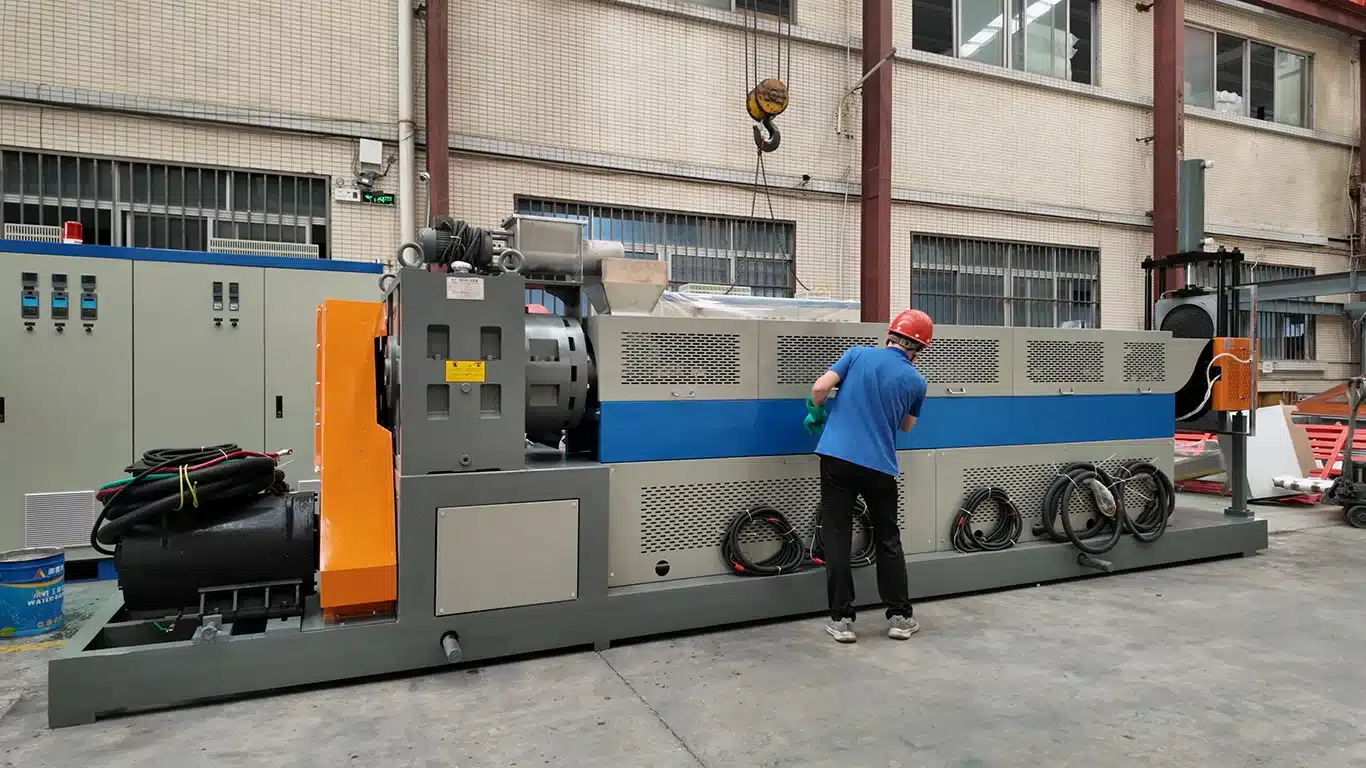
HuaZhao Plastic Machinery factory headquarters and manufacturing facility in China

3. Selection Guide for B2B Buyers

  • Choose a Vented Single Screw Extruder / Single Vent when: You are processing clean factory scrap or pre-dried raw materials with low moisture content, where basic degassing is sufficient and cost-efficiency is prioritized.

  • Choose a Vented Twin Screw Extruder / Double Vent when: You operate a vented recycling extruder line processing post-consumer washed films, high-moisture agricultural plastics, or high-value engineering plastics that demand rigorous devolatilization and zero porosity.

Frequently Asked Questions (FAQ) for B2B Buyers

Q: Is the output and power consumption of a double exhaust pelletizer always higher than a single exhaust model?

A:

A double exhaust pelletizer’s output is not solely determined by the number of exhaust ports; it primarily depends on the length-to-diameter ($L/D$) ratio, screw configuration, and motor power. However, because double exhaust systems require longer screws to accommodate two-stage devolatilization (typically a higher $L/D$ ratio), the total power configuration and equipment investment will be higher than single exhaust models. Nevertheless, for high-moisture materials, double exhaust prevents frequent strand breakage, ultimately boosting overall effective output when looking at overall equipment effectiveness (OEE).

Q: Do raw materials still need to be pre-dried when using a double exhaust system?

A:

This depends on the initial moisture content of the material. For extremely wet washed scrap, while double exhaust offers powerful devolatilization, excessive moisture can still exceed the limit of the first exhaust port, causing “spitting” (melt overflowing from the port). Therefore, for materials with surface water or high humidity, we recommend pairing with a simple dewatering or pre-drying unit to ensure the double exhaust system runs stably and efficiently.

Q: How can I resolve "spitting" at the exhaust port?

A:

Exhaust port spitting is a common pain point in B2B production. Common causes include: excessive vacuum pressure, over-filling of the screw channel beneath the exhaust port, excessive raw material moisture, or improper temperature settings. Optimization recommendations:

  1. Adjust the temperature of the corresponding zone to lower the melt viscosity/flowability.

  2. Modify the screw configuration (add reverse-flight elements or mixing elements directly under the exhaust port to create appropriate pressure/resistance and reduce material fill volume).

  3. Appropriately regulate the vacuum pump suction valve opening.

Q: How should I communicate my exhaust requirements to the equipment supplier during procurement?

A:

To ensure you purchase the right matching equipment, we recommend providing suppliers with the following key parameters:

  • Material Type: Virgin resin, industrial scrap, post-consumer recycled flakes, or washed material?

  • Initial State: Pre-dried or not? What is the estimated moisture content?

  • Downstream Application: Blown film, injection molding, or pipe extrusion? What is your tolerance for bubble defects and granule density?

  • Output Requirement: Target output per hour (kg/h). Suppliers will use these data points to match you with the optimal screw $L/D$ ratio and single/double exhaust setup.

Q: How does an extruder venting system prevent polymer degradation?

A:

By applying precise negative pressure through the extruder vacuum vent, moisture and trapped solvents are instantly removed. This prevents hydrolytic degradation—especially in moisture-sensitive plastics like PET and PA—protecting the polymer molecular chains.

Q: Can a standard single-vent extruder be modified into a vented recycling extruder?

A:

It depends on the L/D (length-to-diameter) ratio of your barrel and screw geometry. Converting to a dual-stage setup requires adequate length for the second melting and devolatilization zones, alongside a professional extruder vent port design to prevent melt bleeding (screw plugging).

Q: What causes melt to push out (bleed) from the extruder vent port, and how can it be prevented?

A:

Vent bleeding usually happens when the feed rate is too high, the vacuum level is unstable, or the screw flight depth at the venting zone is improperly matched. Optimizing the extruder vent design and using specialized barrier or mixing elements helps maintain a stable, thin melt film that releases gas without leaking material.

Get Your Free Recycling Solution

Contact Form Demo